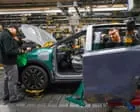
Major carmakers privately lobbied the UK government to revoke a ban on new petrol and diesel cars after 2035, according to documents that reveal for the first time the efforts to overturn a key decarbonisation policy. BMW, Ford, Nissan and Toyota, plus the parts maker Bosch, wrote a joint letter to ministers in April calling for an “open technology approach” including petrol and diesel cars after 2035, when the government had said new cars must produce zero carbon emissions. The letter was obtained by The Fast Charge newsletter via a freedom of information request and shared with the Guardian.
The companies wrote that the government should allow “highly efficient ICE [internal combustion engines], hybrids, plug-in hybrids, range extenders and combustion engines when utilising green steel and sustainable fuels” beyond 2035. All those technologies produce carbon dioxide by burning fuel, as well as other harmful pollutants. The 2035 ban on sales of new petrol and diesel cars is a cornerstone policy in cutting the UK’s carbon emissions.
The switch to electric vehicles is the single biggest contributor to cutting UK carbon pollution in the next decade, according to the government’s Climate Change Committee. A government spokesperson said the 2035 ban was not up for negotiation. Yet successive governments have weakened battery EV policies.
Labour has already introduced “flexibilities” into electric vehicle targets that run up to 2030. The government is now considering further changes to the rules, known as the zero emission vehicle (ZEV) mandate, after strong lobbying by carmakers. The suggestion of revoking the 2035 ban was heavily criticised by campaigners and Polestar, an EV brand.
Matt Galvin, managing director of Polestar UK, said: “Reversing the transition to pure electric vehicles in the middle of a climate emergency would be a historic policy failure. The technology exists, consumers are embracing it and the economic case is becoming stronger every year. There is simply no justification for prolonging our dependence on petrol and diesel.
“Rather than reopening the door to new petrol and diesel sales, policymakers should be accelerating the transition by removing the barriers that still prevent millions of drivers from switching.” The manufacturers have sway with the government because they employ 30,000 people in the UK. BMW owns the Mini factory in Oxford and Rolls-Royce in West Sussex, Nissan has the largest UK car factory in Sunderland, and Ford has factories in Dagenham near London and Merseyside. The companies said in the letter that a “multipath strategy” should match the EU, which weakened its own electric car targets in December to enforce 90% electric car sales after 2035, down from 100% before.
The letter requested a meeting with the then ministers for Wales, Northern Ireland and Scotland to discuss the mandate, suggesting that carmakers were trying to build up broad support for diluting the targets. The companies believed that the extra emissions could be offset by using lower-carbon steel and “e-fuels” – petrol made using green electricity. However, experts say e-fuels are not viable on a large scale because of massive energy wastage.







Comentários (0)
Entre ou cadastre-se para comentar.