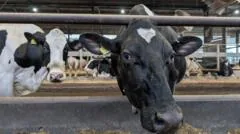
How farmers could fix Wales' polluted rivers and save money - Published Farmers have a crucial role in cleaning up one of the UK's most polluted river systems and could save money in the process, a new study has shown. The eastern and western Cleddau rivers in Pembrokeshire flow through farmland which produces as much as 25% of Wales' milk. Researchers from Lancaster University found the area's farms were buying in far more fertiliser and processed animal feed than needed, causing a build-up of phosphorus in the soil and polluting waterways.
Now - in what's thought to be one of the largest projects of its kind in the world - hundreds of dairy farms are working out their "nutrient footprint" to help tackle the problem. "The Cleddau is quite an extreme case," said Ric Cooper, of The Cleddau Project, a group of local volunteers working to restore the rivers, which are designated special areas of conservation (SACs). "We have one of the highest densities of dairy cows in the country [here] - it's a very successful and important industry for Pembrokeshire...
[but] we also have a river that's not coping." In recent years the Cleddau rivers have been branded Wales' poorest performing protected waterways by environment watchdog Natural Resources Wales (NRW). They suffer from elevated nutrient levels, which can lead to the growth of algae, depriving fish and other aquatic life of oxygen. The situation's so serious it's recently led to limits on house building, while campaigners have warned of "ecological disaster".
Phosphorus - found in fertiliser and processed livestock feed - is considered to be one of the substances of most concern. While sewage discharges, misconnected drains and industrial run off are also factors, this new research - funded by the Welsh government - finds agriculture to be "the primary driver" of phosphorus pollution in the Cleddau rivers. Lancaster University's RePhoKUs team, external looked in detail at all of the phosphorus being imported into the area as well as how much then left again in milk, cheese or other products.
The conclusion was that far more phosphorus was coming into the catchment than was being removed through food production. Local farms were generating a combined annual surplus of about 360 tonnes - the equivalent weight of 26 double decker buses' worth - of phosphorus was left behind in the land, which can continue polluting waterways for decades. What's more - they found that in theory there was no need for farms to be buying in so much artificial fertiliser, in particular, with enough phosphorus in animal manures across the county to meet crop requirements according to Prof Paul Withers, who led the research.
It means farms could potentially cut down significantly on expensive bought-in fertiliser by spreading their cows' slurry and manure more effectively - saving the county's farmers an estimated £1.08m a year. Dairy co-operative First Milk, which has a large cheese-processing plant in Haverfordwest, Pembrokeshire, is trying to address the situation with all 700 of its farmers across the UK - including 200 in west Wales. The group has recently worked out the nutrient footprint of each farm - closely scrutinising use of bought-in feed and fertiliser.





Comentários (0)
Entre ou cadastre-se para comentar.